Foodstuff Africa Community (FAfCom) has already established itself as a transformative model in Africa’s digital economy, where foodstuff is no longer just a consumable necessity but a tradable, wealth-generating asset.
If you have been following the FAfCom vision, you already understand the core foundation: it is a decentralized marketplace where foodstuff commodities are represented as Funds or Indices, backed by real economic demand and tied to Zero Hunger Coin (ZHC), the currency that binds the entire ecosystem.
Now, at the heart of this innovation lies the FAfCom Foodstuff Fund – a collection of indices that mirror real-world food prices and create financial opportunities for every shareholder within the community.
This blog post will dive deep into the concept of Foodstuff Funds, how they work, why they matter, and how you can leverage them through Swiping to earn consistent financial rewards.
What Are FAfCom Foodstuff Funds?
A Foodstuff Fund in FAfCom is not just a theoretical financial instrument. It is a carefully designed digital representation of Africa’s most demanded staple commodities, transformed into Foodstuff Indices that can be bought, held, and traded.
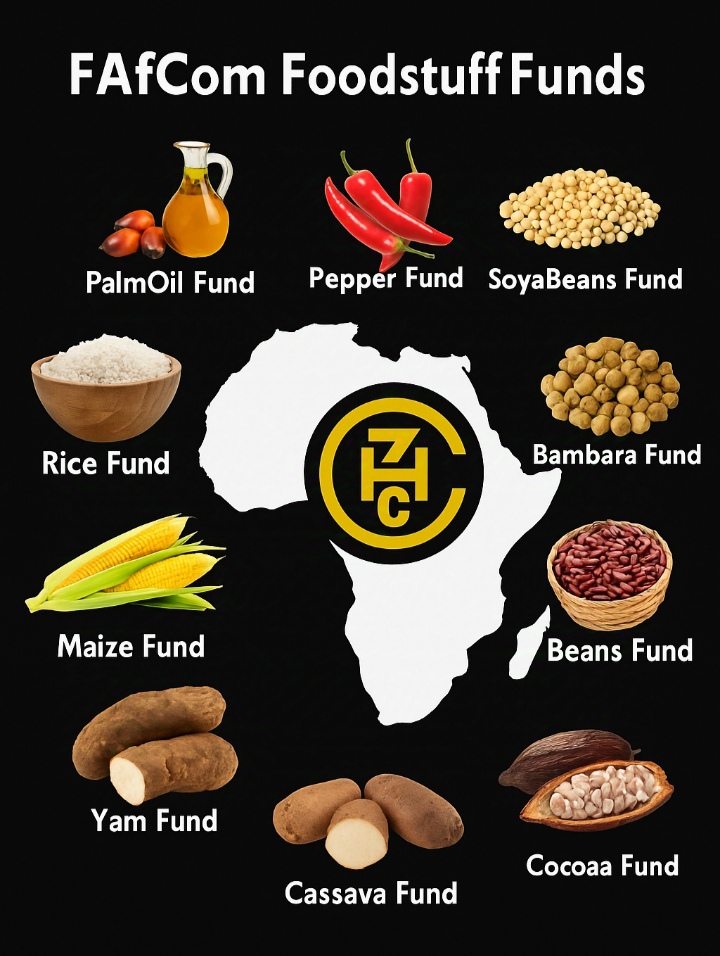
Currently, FAfCom hosts 10 Foodstuff Funds:
1. PalmOil Fund
2. Pepper Fund
3. SoyaBeans Fund
4. Bambara Fund
5. Cocoa Fund
6. Rice Fund
7. Maize Fund
8. Yam Fund
9. Cassava Fund
10. Beans Fund
Each of these Funds has a fixed total supply of 10 million metric tonnes, equivalent to 10 billion kilograms, giving them stability and scarcity. Unlike traditional food markets, where supply can fluctuate drastically, the fixed supply ensures predictability and creates long-term value for shareholders.
Why Foodstuff Funds are Essential in Foodstuff Africa Community
Food is Africa’s most critical economic backbone. Every household, small or large, interacts daily with these commodities. By transforming food into tradable digital Funds, FAfCom is doing two things simultaneously:
1. Creating an Inclusive Investment Gateway
Anyone, regardless of background or wealth, can buy into food-based assets. Instead of needing a warehouse full of rice or a farm of palm trees, a shareholder can hold digital indices that mirror the same value dynamics.
2. Stabilizing Wealth Against Inflation
Inflation is a constant threat in African economies. But food remains one of the most inflation-resistant assets. A shareholder holding units of the Rice Fund or PalmOil Fund, for instance, is shielded against the daily erosion of purchasing power.
3. Linking Daily Life with Digital Wealth
Unlike abstract digital tokens that many struggle to relate with, Foodstuff Funds are tied to everyday items. People understand rice, maize, cassava, and palm oil, so they can connect easily to the logic behind their value appreciation.
How FAfCom Foodstuff Funds Work
Think of Foodstuff Funds as digital indices that track the price behavior of their real-world counterparts. For example:
– If the price of rice in Africa rises due to scarcity, transportation costs, or increased demand, the Rice Fund mirrors this upward movement.
– If global cocoa prices fluctuate due to international trade dynamics, the Cocoa Fund reflects that change.
This mirroring mechanism ensures that FAfCom’s Funds are not operating in isolation; they are grounded in real-world economic activity.
Every Foodstuff Fund is denominated in ZHC (Zero Hunger Coin), which serves as the universal share/currency across the community. Owning ZHC and Foodstuff Funds together provides the true power of wealth creation within FAfCom.
The Role of ZHC in Foodstuff Funds
Zero Hunger Coin (ZHC) is the bloodstream of FAfCom. Without ZHC, the Foodstuff Funds would not be fully functional. Here’s why:
– ZHC acts as the bridge that connects all shareholders to the Foodstuff Funds.
– It is the unit of account and exchange, ensuring that trading, swiping, and distribution of rewards happen smoothly across the platform.
– ZHC ownership signifies community membership and participation, while Foodstuff Fund ownership signifies direct asset holding and exposure to foodstuff price movements.
To maximize opportunities, an investor typically holds both ZHC and Foodstuff Funds.
FAfCom Swiping: The Engine of Financial Rewards
Owning Foodstuff Funds is not just about holding them in your portfolio. FAfCom introduces a powerful mechanism called Swiping – the process of providing liquidity to the Foodstuff Indices in exchange for USD-denominated rewards.
Here’s how it works:
1. A shareholder allocates part of their Foodstuff Funds into Swiping pools.
2. These pools enhance the liquidity of the Foodstuff Indices, ensuring smoother buying and selling within FAfCom.
3. In return, the shareholder earns small but consistent financial rewards in USD.
While the rewards per swipe might seem modest, they accumulate over time, especially as one builds a larger holding across multiple Foodstuff Funds. It is a classic example of how small streams of income can build into rivers of wealth.
Swiping is not speculative gambling; it is a service to the ecosystem that comes with financial incentives. This makes it more sustainable than many traditional or token-based reward systems.
Advantages of Investing in Foodstuff Funds
1. Diversification
With 10 FAfCom Foodstuff Funds available, you can diversify across different food categories, balancing risk and reward. For example, while Cocoa Fund may be influenced by international exports, Yam Fund may rely more on domestic consumption trends.
2. Fixed Supply – Unlimited Demand
Each Fund is capped at 10 billion KG, but food demand continues to grow exponentially across Africa’s 1.4 billion people. This creates a natural supply-demand imbalance favorable to long-term value growth.
3. Accessibility
Unlike physical farming or commodity trading, Foodstuff Funds don’t require massive capital or logistics. Anyone can participate, starting small and scaling over time.
4. Daily Rewards via Swiping
Beyond price appreciation, shareholders earn steady cash flow through swiping, providing both short-term income and long-term growth.
5. Community-Driven
Since FAfCom operates as a community-owned platform, participants benefit not just from personal earnings but also from the collective growth of the ecosystem.
Real-World Use Case Example
Imagine a shareholder who allocates their portfolio across Rice Fund, PalmOil Fund, and Cassava Fund. As food prices in Nigeria rise due to inflation and logistics issues:
+ Their Rice Fund appreciates in value.
+ PalmOil Fund, tied to international trade, also appreciates.
+ Cassava Fund remains stable but generates swiping rewards.
This shareholder is simultaneously protecting wealth, gaining exposure to commodity-driven growth, and receiving cash flow rewards – all through the FAfCom ecosystem.
The Bigger Vision of FAFCOM Foodstuff Funds
FAfCom Foodstuff Funds are not just about individual profits. They represent a larger mission:
Financial Inclusion: Empowering Africans who were previously excluded from sophisticated investment models.
Food Security Awareness: Creating economic incentives that tie directly to the continent’s most pressing resource – food.
Global Recognition: Positioning Africa’s food economy as a tradable digital frontier on par with stocks, forex, and cryptocurrencies.
The ultimate dream is that one day, just as people globally trade gold, oil, or stocks, they will also trade FAfCom Foodstuff Funds as credible financial assets backed by real demand.
For those already part of the Foodstuff Africa Community, understanding and engaging with Foodstuff Funds is not optional – it is central to maximizing your role in the ecosystem.
+ Owning ZHC gives you membership.
+ Owning Foodstuff Funds gives you assets.
+ Swiping gives you financial rewards.
Together, they form the three pillars of wealth creation within FAfCom.
As Africa continues to redefine how resources are valued and traded, the Foodstuff Fund stands as a beacon of how everyday necessities can be transformed into long-term wealth vehicles for individuals, families, and communities.
So, whether you are holding the Rice Fund, Cocoa Fund, or Yam Fund, remember this: you are not just an investor – you are a co-owner in Africa’s future food economy.