The journey of Foodstuff Africa Community (FAfCom) has always been about one central mission: to give Africans ownership of their food economy. With millions across the continent struggling with unstable food prices, middlemen exploitation, and poor distribution channels, FAfCom has built a decentralised ecosystem where ordinary people become shareholders, and where food production, pricing, and distribution are shaped by collective ownership instead of control by a few.
At the heart of this system is Zero Hunger Coin (ZHC) – the currency and share of FAfCom. With a total supply of 10 billion ZHC, it operates on free market dynamics, just like company shares, except that it is decentralised and people-driven. After the successful distribution of ZHC, FAfCom is launching its next revolutionary tool – the Zero Hunger Foods Voucher – a smart and practical system that allows people to buy real foodstuff directly using ZHC while enjoying stability, transparency, and access across Africa.
What Exactly is a Zero Hunger Foods Voucher?
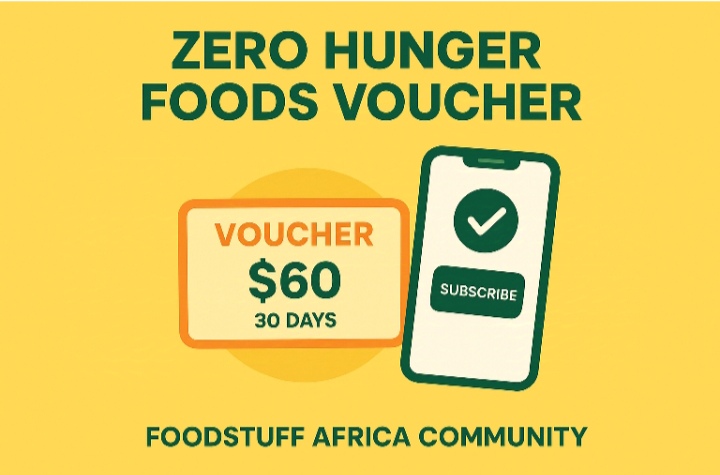
In simple terms, a Zero Hunger Foods Voucher is a digital food ticket that guarantees you a specific price for a particular food item within a set period. It is created by FAfCom Distributors (who are also shareholders) and displayed on the FAfCom Marketplace.
Here’s how it works:
- A Distributor creates a Sell Order Voucher for a foodstuff item (e.g., rice, beans, yam, maize).
- The voucher has:
- A fixed price (quoted in USD for standardisation),
- An expiry date (after which it becomes invalid),
- A unique voucher name (e.g., July Rice Voucher).
- A Shareholder (Fafcomite) can browse through the FAfCom Marketplace, filter available vouchers by country and city, and subscribe to the one that suits them.
- To subscribe, the shareholder pays a fixed subscription fee of 100 ZHC.
- Once subscribed, both the distributor and the buyer receive notifications, and they can directly connect through the distributor’s registered phone number.
This means FAfCom does not act as a middleman – instead, it provides a trustless decentralised platform where buyers and sellers interact transparently.
Why Vouchers Instead of Direct Pricing?
In Africa, one of the greatest problems in food trade is price instability. A bag of rice can be ₦65,000 today and ₦70,000 tomorrow, only to fall back to ₦62,000 within weeks. For distributors and customers, this creates tension, mistrust, and losses.
The Voucher Model solves this problem elegantly:
- Price Lock-In: If a voucher is created for ₦65,000, it remains at that price until expiry. This protects both the customer (from sudden hikes) and the distributor (from constant renegotiation).
- Expiry Dates: Once the voucher expires, the distributor can create a new one reflecting updated market prices. This ensures orderliness.
- Fairness: Customers who subscribed earlier enjoy lower prices for as long as their voucher lasts, while new buyers enter at the new rate.
This system is not entirely new – it mirrors how company shares, subscription plans, or airline ticket pricing work. Early buyers lock in cheaper rates, while later buyers adjust to new market realities.
Features of FAfCom Zero Hunger Foods Voucher
- Decentralised Distribution: Each distributor operates independently from their city or country, but their vouchers are visible across Africa.
- Transparency: Distributor’s business name and phone number are registered permanently. This builds trust and accountability.
- Standardised Pricing: Foodstuff prices in vouchers are quoted in USD to prevent confusion across currencies, while subscriptions remain in ZHC.
- Subscription Fee: Each voucher requires a 100 ZHC subscription fee – this ensures only serious buyers subscribe and gives distributors consistent income.
- Search and Filter: Buyers can filter vouchers by country and city, making it easy to find local suppliers.
- Notification System: Both distributor and buyer get instant alerts when a subscription is made, ensuring fast communication.
Example: How a Voucher Works
Let’s say Chinedu, a FAfCom Distributor in Lagos, creates a “September Rice Voucher.”
- Item: Rice
- Price: $60 per 50kg bag
- Expiry: 30 days (till 30th September)
- Subscription Fee: 100 ZHC
👉 Ada, a shareholder in Lagos, sees this voucher and subscribes. She pays 100 ZHC, gets notified, and contacts Chinedu directly. For the next 30 days, she is guaranteed rice at $60 per bag, no matter what happens in the market.
👉 Bayo, another shareholder in Lagos, delays till October. By then, Chinedu creates a new voucher at $70 per bag due to rising market prices. Bayo must now subscribe at the new rate.
This system creates urgency for buyers and predictable income for distributors.
Why the Voucher System is Powerful for Africa
- Stability in a Volatile Market: Africans suffer the most from unstable food prices. Vouchers give families confidence to plan ahead.
- Direct Access to Foodstuff: No middlemen or hidden costs – buyers connect directly with distributors.
- Incentives for Shareholders: Distributors earn ZHC subscriptions, while buyers enjoy fair and predictable food pricing.
- Scalability: The system can easily expand across multiple cities and countries without needing a central office.
- Wealth Creation: Just like people make millions from company shares, FAfCom shareholders will make wealth from ZHC and food vouchers, but in a decentralised, collective-driven economy.
The Future of FAfCom Marketplace
The Zero Hunger Foods Voucher is not just a tool – it is a gateway to Africa’s food sovereignty. Imagine a system where:
- A farmer in Ghana creates a maize voucher, and a buyer in Nigeria subscribes.
- A distributor in Nairobi sets yam vouchers, and a family in Mombasa locks in the price.
- Across Africa, millions of people trade food transparently, with no government bottlenecks, no middleman exploitation, and no currency instability.
This is the power of FAfCom: a community-owned decentralised food economy that not only puts food on the table but also creates wealth for its shareholders.
Conclusion
The Zero Hunger Foods Voucher is the next big step in FAfCom’s mission to control foodstuff production and distribution across Africa. It solves the age-long problem of price instability, builds trust between buyers and sellers, and empowers shareholders to take ownership of Africa’s food system.
With ZHC as the backbone and the voucher system as the marketplace engine, FAfCom is setting the stage for a new era of decentralised, transparent, and people-driven food economy.
The future of food in Africa is not in the hands of governments or corporations – it is in the hands of the people, the shareholders, the distributors, and the farmers who together make FAfCom a reality.